In September I wrote about four classes and their four tensions. I still love the ideas in that post. But over the autumn the world around those classes changed so much that they stopped fitting it.
Caelwick became a town of four thousand people with trades and character sheets. Its gods got their own aether. Its street lamps, forges and mills run on crystals that only the tower provides. Magic stopped being something only heroes do and became the thing the whole economy runs on. A class system designed before any of that existed was always going to creak.
So this is a fresh start. None of what follows is built yet. It's the design, settled over a long run of conversations about how combat should fit the world. I've left the numbers out on purpose, because the shape comes first.
Aether, briefly
Aether is crystal that grows where the tower's magic pools, and it comes only from the tower. Most of it is Gray: common, and on its own good for little more than light. Every street lamp in Caelwick is a chip of plain Gray.
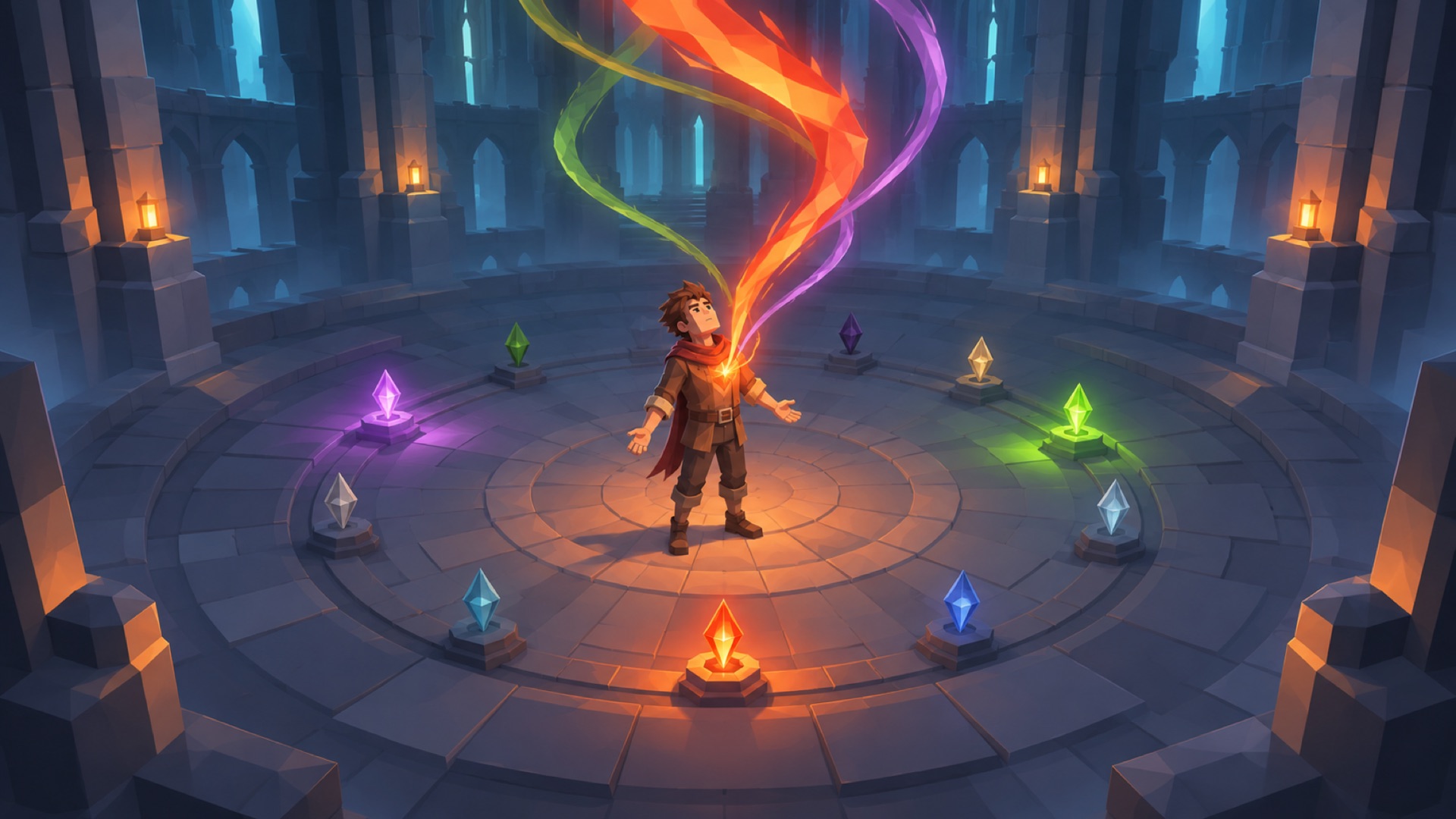
Rarer are the ten typed aethers, in five opposed pairs: Fire and Water, Earth and Air, Light and Shadow, Life and Death, Force and Mind.
In town, the types are cut into devices as runes. Fire runes give a forge its heat, Force runes turn a mill, Mind runes carry messages. In a fight they mean something too. Fire is burst and burning ground. Water slows and pushes. Shadow is stealth and fear. Mind is interrupts and reading intent.
The mark
The newly woken arrive in Caelwick with no aether at all. Then the tower tests them. A trial inside marks a person with three of the ten types: one primary and two secondary.
That mark replaces the class. You aren't a Warden or an Elementalist. You're a Fire-marked delver with Earth and Mind behind it, or a Life-primary with Shadow and Force. Ten types taken three at a time, with one of the three as primary, gives far more combinations than four classes ever could. Each one leans somewhere different.
And being marked is a choice. Not everyone in Caelwick takes the trial, and the unmarked have their own way into magic (more on that below).
A pool for each type
A marked person carries health and one pool for each of their three types. There's no generic mana bar, no stamina and no spell points.
An ability spends its own type. When your Fire runs dry, your fire abilities are gone, and you fight on with the other two. Your basic attack is always free. That's the tension I wanted at the heart of every fight: you're not managing one resource, you're managing three, each tied to a different way of fighting. Spend the Fire early to break the line, or hold it for whatever comes through the door next?
Your strength in a type comes from the size of its pool, not from what's left in it. A full pool and a nearly empty one hit equally hard. The empty one just can't do it again.
Magic items you wear draw on your aether, too: worn enchantments take a share off the top of every pool. They cost you room to spend, not strength.
The soul tree
Instead of a class talent tree, every marked person has one dense map of nodes in their soul, with themselves at the centre.
- Ten starting points sit on a ring, each type directly across from its opposite. You begin at the three your mark gave you.
- A circle grows around each of your three starts. You can take any node inside a circle that connects back to its start. Each circle grows with how much of that aether you hold, so your primary's circle is the largest.
- Nodes follow what a type stands for, not the type itself. Fire's region is about burst and aggression. Water's is control and flow. Earth's is holding and endurance. Air's is reach and movement, Light's sight and warding, Shadow's evasion and fear, Life's recovery, Death's attrition and draining, Force's momentum and impact, Mind's timing and focus. Those nodes improve everything you do, so the ground between your circles is always worth reaching for, marked or not.
- The tree changes abilities; it never grants them. The tree shapes how your abilities work. It doesn't hand you new buttons.
- Items sit on the outer edge. Place an item at a spot one of your circles has reached, and it opens keystones of its own, fuelled by your nodes.
What I love about this is that growth has a direction. A Fire-primary with Water as a secondary watches two circles grow toward each other across the ring. The ground between them, where burst meets control, is a build that only that mark can grow into.
Rungs: growing in the tower
You grow your aether by spending it. Defeating monsters gives experience in the types you used. Tower monsters also carry cores of their own type. A core is clean to those who were there at the kill and dirty to anyone else, bought cores included. You can't just buy your way up.
Power and rank grow separately. How much aether you hold grows your circles. To climb a rung, you need enough of every one of your marked types, primary and both secondaries, and then a passage through the tower. Passing it lets your circles grow further, and lets you reshape your tree for free.
Same rules for everyone
This connects straight back to the character sheets. A delver has the same six attributes as the baker next door. Abilities need a rank in their skill, the same requirement for everyone. Someone with no mark can still use magic: they channel it from a core they carry, of any type they have the skill for. The marked spend their own aether and get their tree on top.
Defending works the same way for everyone too. There are four defenses: Evasion for whether a blow lands at all, Body for poison and knockdown, Mental for fear and charm, and Soul for anything that would change what you are, such as possession, binding or having your aether drained.
What's still open
A lot, honestly. How attributes grow. Whether weapons get skills of their own. Which guilds teach which abilities. How pools refill mid-fight. What sits at the very centre of the tree, which I've deliberately reserved for something special. And every number.
The four classes did their job: they taught me what I wanted a fight to feel like, with a rhythm, a fuel and a dilemma. The mark keeps all three. It just lets the world, and the tower, decide what yours will be.