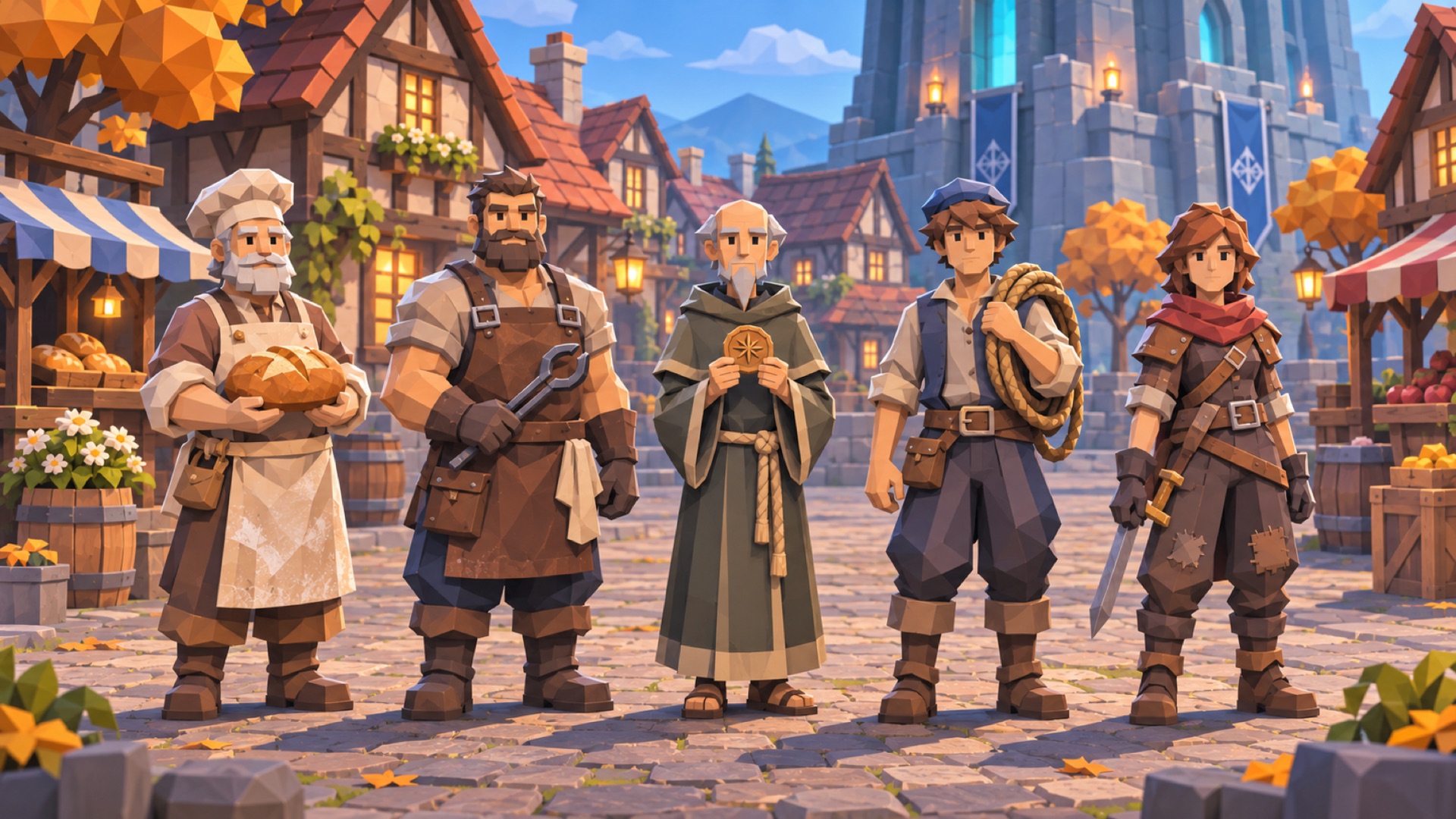
For most of this year, Caelwick's character sheet belonged to adventurers. It had nine skills, and you earned ranks in them by gaining class levels in the tower. That works fine if the only people in the world are delvers. It falls apart the moment you ask a simple question about the town: how did the baker get good at baking?
She didn't climb the tower. She got up before dawn for twenty years.
The town has grown into something much bigger than a hub with a few shops. I wanted Caelwick to feel like a real place where adventuring is one way to make a living among many. So the rule I set myself was this: everyone in Caelwick has a character sheet, and it is the same sheet.
Today that means 4,108 people in 1,152 households, and every one of them has a sheet.
The body: six attributes
Every resident has the same six attributes a delver has: Strength, Dexterity, Endurance, Intellect, Willpower and Charisma. They're on the same scale as a starting character, so you can put a dockhand next to a fresh delver and compare them directly.
What a life asks of a person shapes where their strengths land. A labourer leans into Strength and Endurance. A scribe leans into Intellect. Delvers get a few more points to spend than the people they live among, so the town's adventurers stand out a little. They're not a different species, though.
What they know: skills for everyone
The nine adventurer skills became one list of 38: crafting skills from smithing to brewing to scribing, gathering skills like mining, fishing and herbalism, lore of the tower, the law, the gods and creatures, and general skills such as medicine, seamanship, commerce and stealth. Everybody draws from the same list. Ranks run from 1 to 6, and having no skill at all is different from having rank 1.
There are three rules I care about most:
- Skills come from practice and teaching, not from killing things. Class levels grant nothing. A rank is something you earn at the bench, in the field or under a master.
- Success is not rolled. If you have the rank and the tools, you can do the job. What varies is quality. A master's loaf and an apprentice's loaf are both bread, but they're not worth the same.
- Skills are noncombat. A high rank in smithing doesn't make you better at hitting someone. It makes you better at making the sword.
How they live: sixteen traits
This is my favourite part of the sheet. Every resident has sixteen traits in four groups:
| Group | It asks | Traits |
|---|---|---|
| Rhythm | How do they spend their time? | energy, calling, ambition, hours |
| Bonds | How do they relate to people? | sociability, loyalty, warmth, trust |
| Conduct | How do they treat others when it counts? | integrity, temper, memory, renown |
| Appetite | How do they handle wants and risks? | thrift, temperance, daring, custom |
Each trait is a scale from −3 to +3 between two poles: restful or restless, solitary or social, forgiving or grudging, cautious or bold, traditional or curious. Neither end is "good". Both poles are a legitimate way to live, and the middle is just average.
Traits aren't skills (what a person knows) and they aren't attributes (what a body can do). They decide how someone tends to act. That matters enormously once the town starts running on its own. When people's days are built, traits decide who lingers at the tavern of an evening, who keeps every service of their god, who is up at dawn and who works by lamplight.
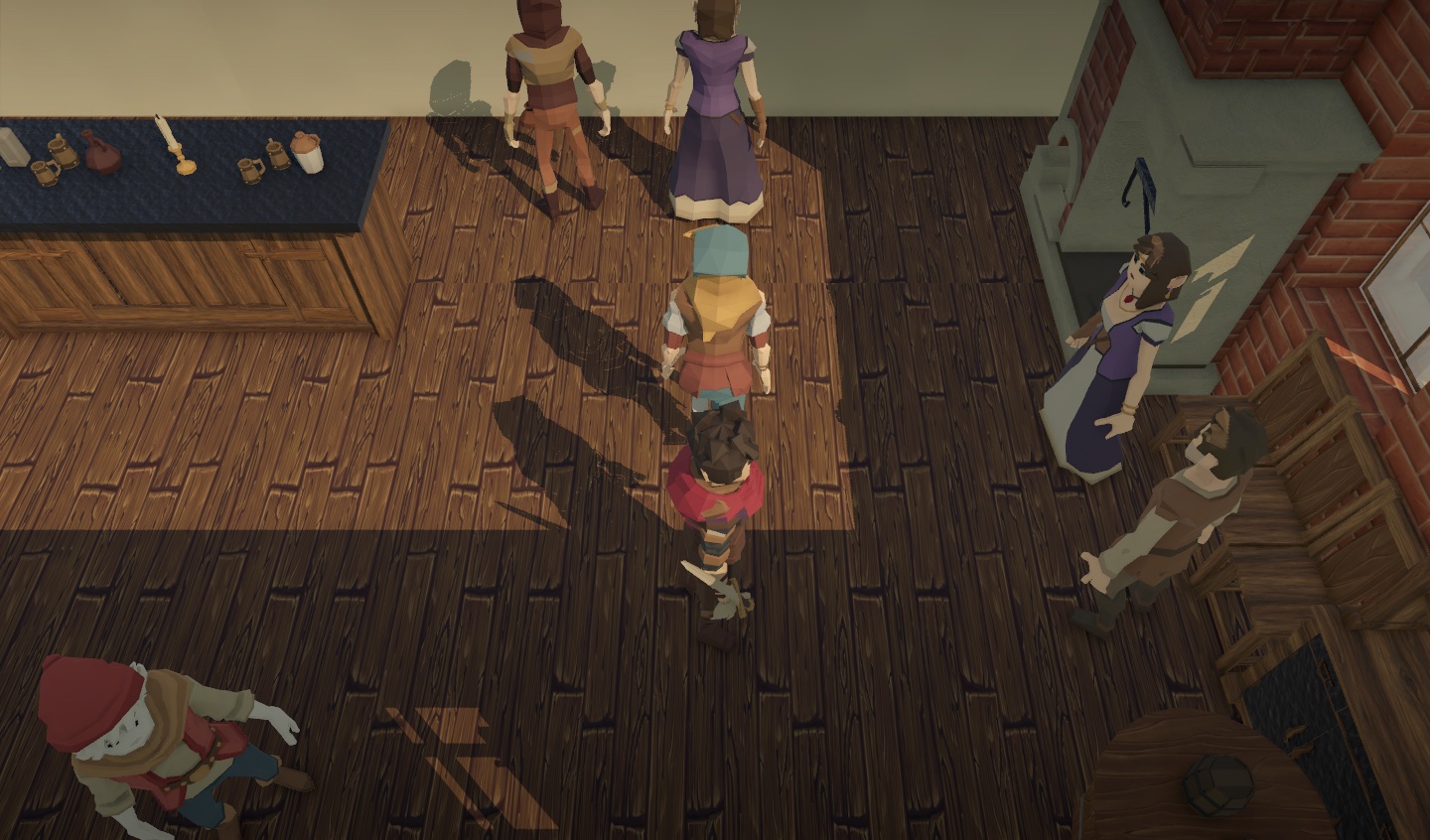
A Southgrid taproom in the current build: the player in the red scarf at the centre, and around the counter and the hearth, people of the town. Development build.
To check that the seeding produces recognisable people rather than noise, I describe a handful of familiar combinations and look for them in the population: the honest merchant, the watch captain, the master smith, the tavern regular, the con man, the delver who carries others out. If I can't find them, something in the numbers is off.
What they love: pastimes and gods
Everyone gets a pastime or two from a list of 32: reading, music, fishing, gardening, carving, gambling, stargazing, bees and doves, and plenty more. Pastimes aren't decoration. They give a household wants. A reader wants a shelf of books, and a library if the house is grand enough. Someone who loves games wants a board on the table.
Caelwick also has twelve gods. Nobody belongs to a faith as a member. Instead each person favours a few gods, from 1 to 3, and that decides which services they keep and how often.
Here's one sheet, picked at random. Abel Bellweather is 67 and has no trade of his own. He has rank 2 in cooking and rank 1 in religious lore. He fishes, he keeps his devotions, and he favours the Long Road above the Threshold. His intellect and willpower are sharp; his strength has gone. He leans a little traditional and more than a little indulgent. Nobody wrote Abel. The seeding made him, and you can read his whole life off one page.
Livelihoods and trades
The sheet also records how a person earns: their livelihood (labourer, skilled worker, apprentice, maker-seller, shopkeeper, merchant, professional, venturer and so on) and their trade, of which the town currently has 107. Livelihood, trade and earnings decide a household's wealth. Wealth, as the next entry will show, decides almost everything about the house they live in.
The baker, the smith, the priest and the delver are all read from the same page.
Why it matters for the player
The end goal is simple to say and a lot of work to reach: the player will use the same sheet as everyone else. You'll be one citizen of Caelwick among four thousand. You'll learn a trade the way they do and pick up pastimes the way they do. Adventuring will be one livelihood among many, a dangerous and lucrative one.
Right now the townsfolk carry their sheets, and the town is built from them. The player's side is being reworked onto the same foundation, and that's the next big piece. It's slower than bolting a few new skills onto the old sheet would have been. It's also the only version where the town and the player live by the same rules, and that's the game I want to make.