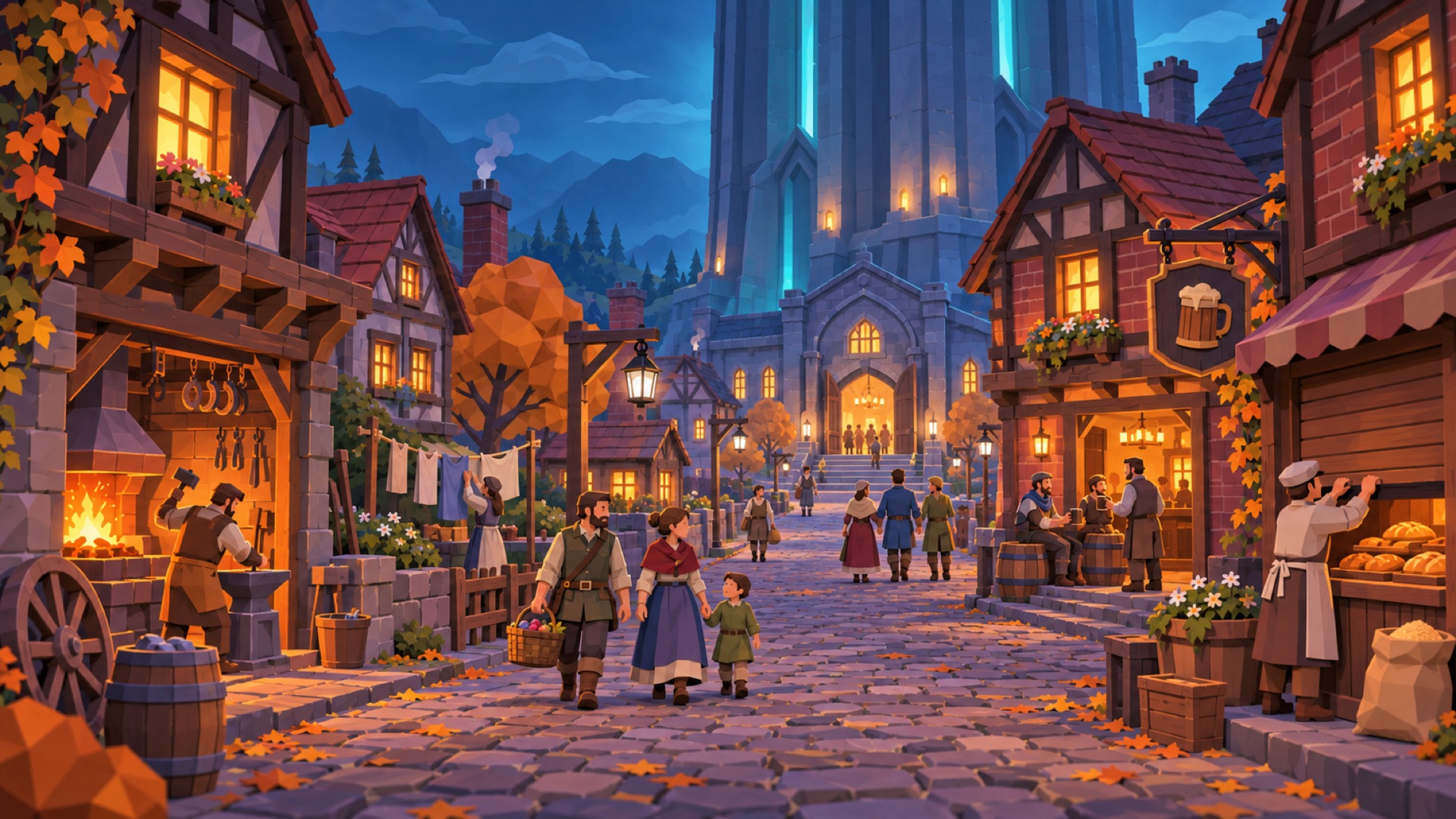
In the last entry I wrote about giving every resident of Caelwick a character sheet. This one is about what those sheets are for.
For a long time I built the town the way most games build towns: design a house, place it, furnish it, design the next one. It looks fine from the street. Open the door, though, and the illusion breaks. Who lives here? Why is there an anvil in a seamstress's front room? Why do four people share a house with one bed?
So I turned it around. Caelwick is built from its people. There are 1,152 households, every member has a sheet, and the town follows from them.
The chain
flowchart TD
  accTitle: How a household becomes a building
  accDescr: A household's sheets decide its earnings and its wealth band; the band gives the home, the trade gives the workrooms, the pastimes give the wants, and together they make the plot, and the plots make Caelwick.
  Sheets[Sheets] --> Band[Band]
  Band --> Home[Home]
  Sheets --> Work[Trade]
  Sheets --> Wants[Pastimes]
  Home --> Plot[Plot]
  Work --> Plot
  Wants --> Plot
  Plot --> Town[Caelwick]
- What they earn. A household's skills and trades decide what it makes, sells or is paid.
- Its band. Earnings place a household in one of six bands: destitute, poor, plain, good, fine or grand. A destitute household might share one room or rent a bed space. A grand one keeps a large house and the servants to run it.
- Its premises. The band picks the home. The trade adds what the work needs: a forge and an anvil for a smith, vats for a dyer, a counter for a shopkeeper. The livelihood decides whether there's a shopfront at all. Pastimes add the wants: a shelf of books, a chessboard, a bench in the garden.
- The plot. All of that gets laid out on a plot that fits it: the house, the yard, the workshop, the garden beds.
- The town. Plots line the streets of each ward, and the wards make Caelwick.
Nothing in that chain is a lookup table saying "a rich family lives in house type B". A cobbler and a clothier with the same income get different houses, because they need different rooms.
Every thing in its place
Here's the part that took the longest, and the part I'm proudest of. Every household owns things: beds for everyone who sleeps there, a table to eat at, chairs, chests, the tools of the trade, a cradle for the baby. Those things have to end up somewhere sensible in the house.
Every kind of room has its own hand-written template: a kitchen, a bedchamber, a smithy, a chapel, a taproom. There are 87 of them now. A template doesn't say "put the bed at these coordinates". It says something more like "the bed goes against the wall away from the door, with a chest at its foot and room to walk round it". The same template then furnishes a cramped one-room flat and a generous master bedroom, each in its own way.
Every room gets furnished this way once, ahead of time, and the game builds each house from the result. Across the whole town that's about 121,000 things: beds, benches, barrels, looms, anvils, crates, lamps and pots. Of those, 120,795 found a proper place, either standing in a room or put away in a store or on a shelf.
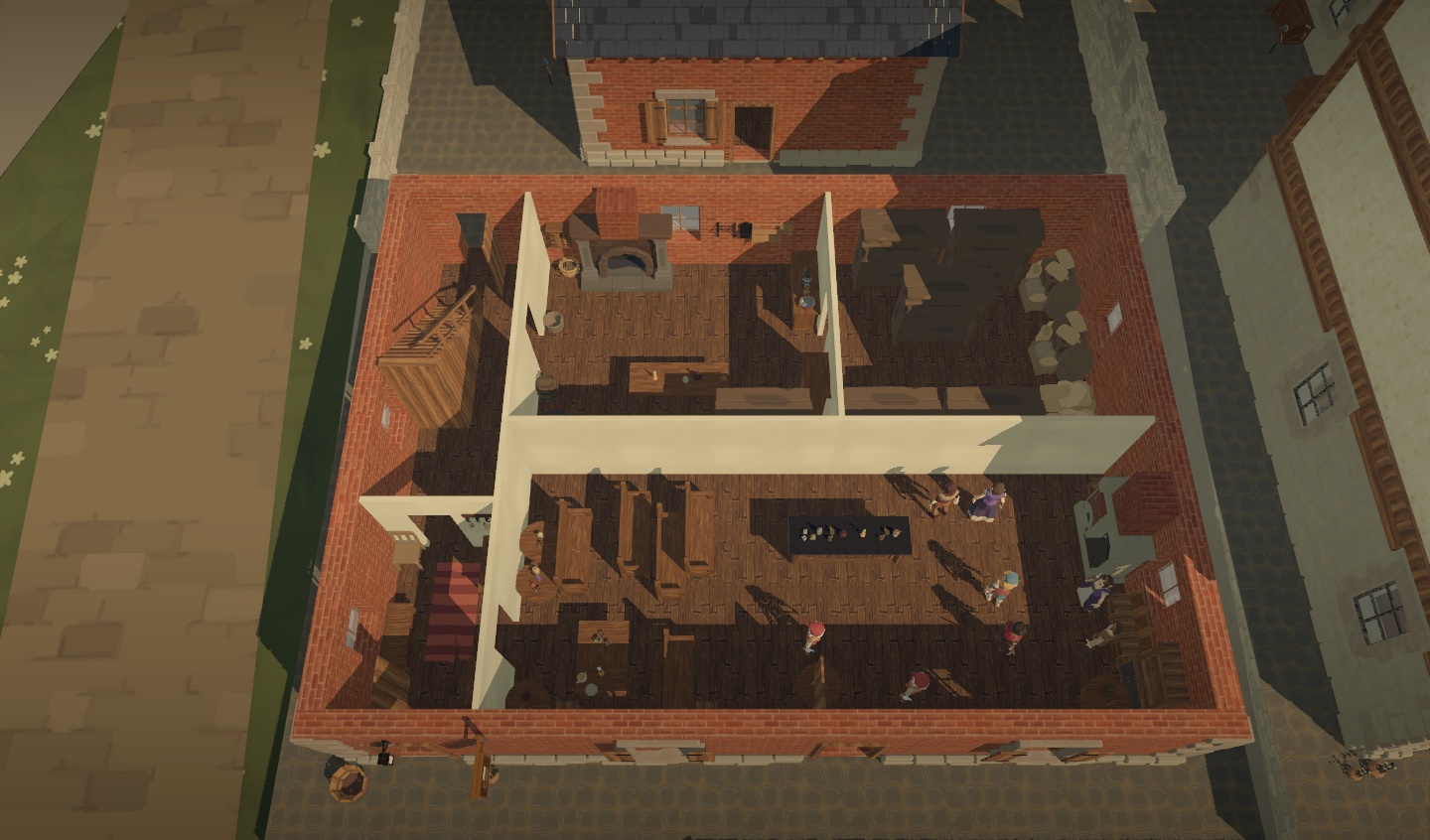
A Southgrid tavern's ground floor in the current build, upper floors cut away: the kitchen and its oven, the store, and the taproom with its benches and counter. Every piece was placed by the household's needs and the room's template. Development build.
The few hundred that didn't are listed, not forced in. I made one rule early and have held to it since:
If something can't fit properly, I'd rather it not be placed at all than be placed wrong.
A wardrobe in front of a window, a bed blocking a door, a chair floating in a wall: those are the bugs that make a town feel fake. A missing chair just goes on a list for me to fix.
Room to walk
Everything also has to be reachable. Every room and every bed, stove, workbench and shelf has to be reachable at the width of a person walking. Each plot is checked on a walking grid, and the streets, squares and doors are surveyed as one map. If any room in town is cut off, the build fails. Today none is.
All 1,750 kinds of thing the town needs now have their own models. That was a long road of its own, and I'm grateful to have it behind me.
A day in Caelwick
A town full of furnished houses is still a set until people live in it. So every resident now has a schedule.
Caelwick runs on a six-day week, each day split into a day half and an eve, with bells at dawn and dusk. The clock runs at ten game minutes for every real minute, so a full day takes about two and a half hours of play. Time passes whether you're in town or deep in the tower.
At any minute of the week, every one of the 4,108 residents has somewhere to be and something to be doing there. They sleep, eat, wash, go to work, visit the market and go home. Traits shape it all: a restless person sleeps less, someone who lives for their pastime spends spare hours on it, a solitary soul stays home of an evening. They walk between places at the game's own pace, through real streets and real doors, into the room their activity happens in. Near you, the game draws up to 300 of them at once. The rest carry on where their schedule puts them, unseen.
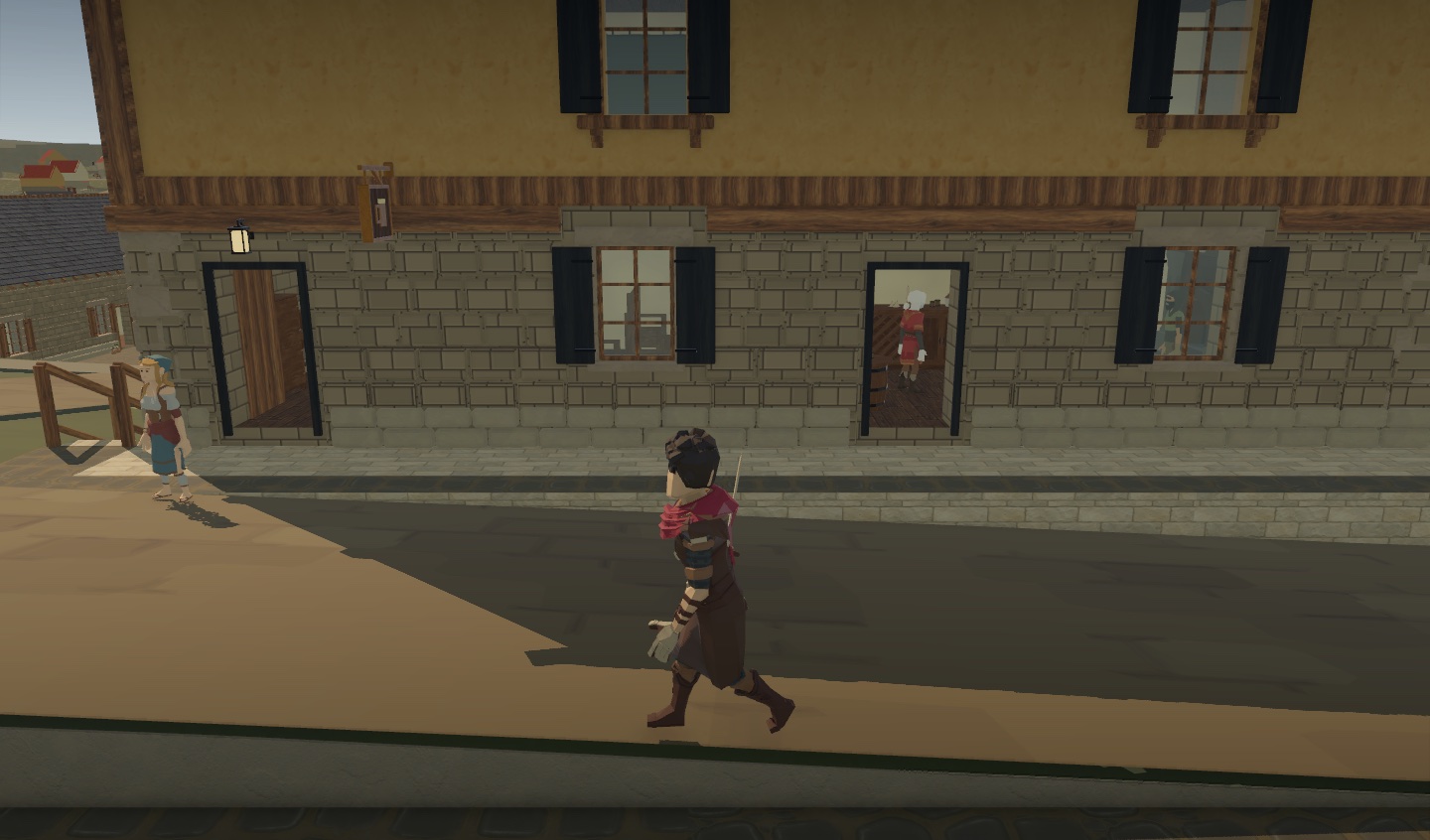
An afternoon in Southgrid in the current build, with people of the town by the steps and inside the shop doors. Development build.
What I'm working on right now is faith and evenings. People keep their gods' services at the ward halls and the order houses, as often as their customs ask. And the taverns finally fill up after dark with the people sociable enough to go.
Why it matters
When you walk into a house in Caelwick, I want every object in it to answer a question. Why is there a loom here? Because the woman who lives here weaves for a living. Why only one bed upstairs? Because the household is poor and the children sleep together. Where is everyone? It's the eve of a service day: the mother is at the ward hall with the rest of her god's faithful, and the father is at the alehouse on the corner, as he is most weeks.
That's the town I want you to come home to after the tower.